

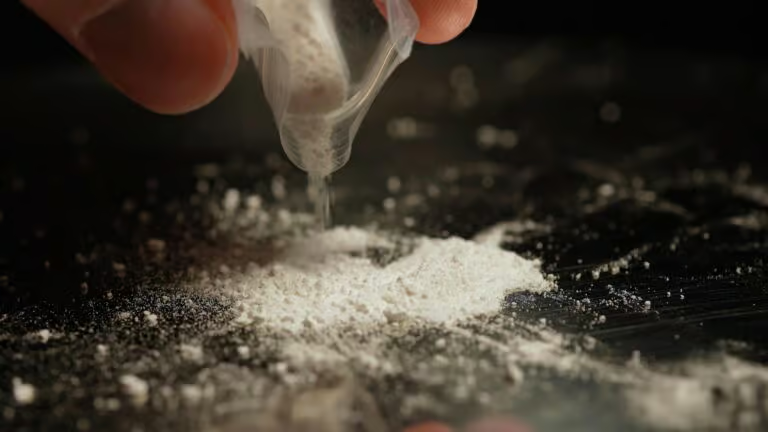
Fentanyl is an opioid 50 to 100 times stronger than morphine, so even a small amount can create serious risk. Its chemical structure helps it act fast but also makes it harder for the body to clear, which leads many people to ask a pressing question: how long does fentanyl stay in your system? Knowing the detection windows gives you a clearer sense of what to expect on a urine, blood, saliva, or hair test, and it can help you take safer, more informed steps toward outpatient treatment and support.
How Long Does Fentanyl Stay in Your System for a Drug Test?
Anyone asking how long does fentanyl stay in your system for a drug test should know that the body processes synthetic opioids differently than natural opiates, so timelines are estimates rather than fixed guarantees. Your unique biology, the amount used, and how often you use all play a role in how long the substance remains traceable. Generally, a specialized panel is required to find fentanyl, since standard opiate screens often miss it completely.
| Test Type | Detection Window | Key Details |
|---|---|---|
| Urine Test | 1 to 3 days (often longer) | Looks specifically for the metabolite norfentanyl. Chronic use can extend this window to a week or more. |
| Blood Test | Up to 12 hours | Fentanyl leaves the bloodstream quickly, making blood tests useful only for very recent exposure. |
| Saliva Test | 1 to 3 days | Less commonly used for opioids but can detect recent use within a few days. |
| Hair Test | Up to 90 days | Provides a long-term historical record of substance use, capturing exposure over several months. |
The most frequently used screening method is a urine test. However, relying on a standard screening to learn how long fentanyl stays in your body can be misleading. Fentanyl breaks down into metabolites, primarily norfentanyl, which linger much longer than the parent drug. Because of this, medical professionals rely on advanced methods like liquid chromatography mass spectrometry to accurately confirm the presence of these specific metabolites. If you are seeking a fentanyl addiction treatment program Massachusetts, clinical teams use these specialized screens to safely guide your initial care and monitor your health.
According to authoritative health resources on opioid testing, urine offers a reliable intermediate window for detection. Blood tests, while highly accurate, are usually reserved for emergency situations because the substance moves out of the blood rapidly. Hair testing offers the longest look back, though it takes time for the affected hair to grow out of the scalp.
Saliva and blood tests both center on very recent use. A blood test may only flag fentanyl for around twelve hours, while a saliva swab can register it for one to three days. Because these windows are short, they are most useful right after exposure rather than for confirming past use. This is another reason the type of test matters so much when people ask how long fentanyl stays in the body.

Check Insurance
We Accept Most Insurance
We are available 24 hours a day, 7 days a week to help you or your loved one understand your insurance coverage. 100% confidentiality guaranteed.
Why Is Fentanyl Detection Different Than Other Opioids?
Fentanyl is a fully synthetic opioid originally developed for severe pain management, such as during surgery or advanced cancer treatment. Unlike natural opiates derived directly from the poppy plant, fentanyl is manufactured entirely in a laboratory. That synthetic nature is exactly what makes illicit fentanyl so potent and so difficult to detect using standard screening tools.
To put its strength into perspective, fentanyl is up to 50 times stronger than heroin and 100 times stronger than morphine. Compared with a common prescription painkiller, it is roughly 50 times more potent than oxycodone. Because of this difference in strength, even a microscopic amount can overwhelm the central nervous system, causing breathing to slow or stop completely. That extreme potency is the primary reason fentanyl carries such a high risk of accidental overdose.
Why Standard Drug Panels Often Miss Fentanyl
Because it is fully synthetic, fentanyl has a unique chemical structure. Standard multi-panel drug tests are typically built to recognize the specific molecular shape of morphine and its close derivatives. The antibodies used in these tests look for that natural opiate structure. When fentanyl passes through the body, its molecular shape is so different that the test simply does not recognize it.
As a result, a person could have a significant amount of fentanyl in their system and still pass a standard 5-panel opiate drug screen, because the test antibodies will not bind to fentanyl or its metabolites. This blind spot is why hospitals, workplaces, and clinics must use specialized fentanyl-specific assays to detect it. If you or a loved one are navigating recovery, finding a dedicated heroin addiction treatment program in Massachusetts that understands the complexities of synthetic opioids is a critical step for comprehensive care.
Why Fentanyl Can Stay in the Body Longer Than Expected
Many people assume that because fentanyl acts so quickly, it must leave the body just as fast. The opposite is often true. The reason fentanyl lingers longer than expected comes down to a specific chemical property: it is highly lipophilic.
Being lipophilic means the substance binds easily to fat. Instead of just circulating in the watery parts of your blood, fentanyl rapidly dissolves into fat cells, known as adipocytes. Picture your body’s fat tissue like a dry sponge soaking up water. When you use fentanyl, it quickly crosses into your brain to produce its effects, but it also gets soaked up by your muscle and fat tissue.
How Fat Storage Extends the Detection Window
Once the drug is stored in these adipocytes, it does not stay there permanently. It slowly leaches back into the bloodstream over time. This process causes protracted clearance, meaning your liver and kidneys have to continuously process the steady trickle of the drug re-entering your system. Because of this slow release, regular users often face a much longer detection window.
Clinical studies show that a regular user can test positive for fentanyl seven or more days after their last use. In some observations, 50 percent of participants continued testing positive at maximum levels two to three days after they stopped. The mean clearance time is around seven days for fentanyl itself and up to 13 days for its metabolite norfentanyl. In extreme cases of heavy use, metabolites have been detected up to 26 days later.
This slow metabolism and delayed clearance answer a common concern directly. Does fentanyl stay in your system longer with repeated use? Absolutely. The more frequently it is used, the more the drug builds up in the body’s fat stores, and that accumulation requires an extended period for the body to fully flush it out.
This prolonged clearance can make early recovery physically uncomfortable. For those seeking structured help to navigate that transition, a comprehensive medication-assisted treatment program can provide the medical oversight needed to manage lingering withdrawal symptoms safely.
Factors That Affect How Long Fentanyl Stays in Your System
No two people clear fentanyl at exactly the same rate. The dose you took, how often you use, and the route of administration all shape how long the drug and its metabolites remain measurable. Larger and more frequent doses saturate the body’s fat stores, which stretches the detection window well beyond what a one-time exposure would produce.
Your individual biology matters just as much. Age, body mass, and overall metabolic rate influence how quickly the liver breaks fentanyl down, while the health of your liver and kidneys determines how efficiently the metabolites are filtered out. Genetics can affect the specific enzymes responsible for metabolism, and heavy alcohol use or certain prescription medications can slow the process even further.
Hydration and so-called detox products do very little to change these timelines. Drinking water supports healthy kidney function, but it does not pull fat-stored metabolites out of your tissue any faster. Detox kits may briefly dilute a urine sample, yet they cannot speed up the underlying biological process of liver metabolism. The most reliable path is time, and for many people, clinical support that makes that time safer and more manageable.
What to Expect as Fentanyl Leaves Your System
As fentanyl clears the body, many people begin to feel withdrawal. Because the drug releases slowly from fat tissue, symptoms can start within hours of the last use and continue as the body works to reach a stable baseline. Common effects include intense muscle aches, nausea, sweating, restlessness, insomnia, and strong cravings.
These symptoms are rarely dangerous on their own, but they are difficult to face alone and are a frequent reason people return to use. Structured outpatient care gives you medical oversight and coping tools during this window without requiring you to step away from work or family. Dual diagnosis support also helps when anxiety, depression, or trauma sit alongside opioid use.
Medication-assisted treatment can ease the physical intensity of this period by reducing cravings and stabilizing brain chemistry, which frees you to focus on therapy. Pairing that medical support with a Partial Hospitalization Program or Intensive Outpatient Program creates a steady framework for the days and weeks when fentanyl is still leaving your system.
Treatment for Fentanyl Addiction
Researching detection times and worrying about drug tests is often stressful, but it can also be a powerful turning point. Realizing that you are carefully tracking how long a substance stays in your body is often the moment you recognize that professional help is needed. Fentanyl addiction is a serious medical condition, and the withdrawal symptoms, from intense muscle aches and nausea to severe anxiety and insomnia, are difficult to face alone. You do not have to fight this without support.
Woburn Addiction Treatment is an accessible option for residents of Middlesex County and the northern Boston suburbs. We understand that adults seeking help for an opioid use disorder have jobs, families, and daily responsibilities they cannot simply abandon, so our programs are designed to fit into your real life.
Flexible Outpatient Care Close to Home
Located right off major commuter routes like I-93 and Route 128, our facility provides highly structured outpatient care without the need for a residential stay. We offer Partial Hospitalization Programs (PHP) for full-day clinical support, along with an intensive outpatient program Massachusetts residents can rely on to balance therapy with their work schedules.
Turn Your Detection Questions Into a Recovery Plan
Understanding how long substances stay in your body can feel overwhelming, but recognizing that you need facts and guidance is a courageous first move. Addiction is a medical condition, not a personal failure, and specialized outpatient care provides the structure needed to safely navigate withdrawal, cravings, and the emotional weight of recovery. You do not have to put your career or family on hold to get the clinical help you deserve.
If you are ready to explore evidence-based treatment options built to fit your daily routine, reach out today. Call (781) 622-9190 to speak directly with the compassionate team at Woburn Addiction Treatment, and we will help you navigate treatment, design a flexible outpatient schedule, and build a clear plan for your health and stability. Contact us today.
Sources
Verstraete, A. G. (June 23, 2004). An overview of the use of urine, hair, sweat and saliva to detect drug …. PubMed.
National Institute on Drug Abuse. (April 2, 2024). Fentanyl Facts. Centers for Disease Control and Prevention.
Substance Abuse and Mental Health Services Administration. (October 17, 2023). Adding Fentanyl to Drug Testing Panel. SAMHSA.
MedlinePlus. (December 8, 2025). Opioid Testing: MedlinePlus Medical Test. MedlinePlus.
Hill, R., et al. (December 23, 2019). Fentanyl depression of respiration: Comparison with heroin and …. PMC.
U.S. National Library of Medicine. (December 1, 2012). Laboratory Testing for Prescription Opioids. NIH.


